Solutions for research and technology domains
Domain- and technology-specific tools and frameworks
Many research domains have established individual tools or frameworks to aid their needs. Some of these solutions such as Sensor Network Ontology are technology-specific rather domain-bound, some are domain-specific, while others comprise many sub-domains and tools.
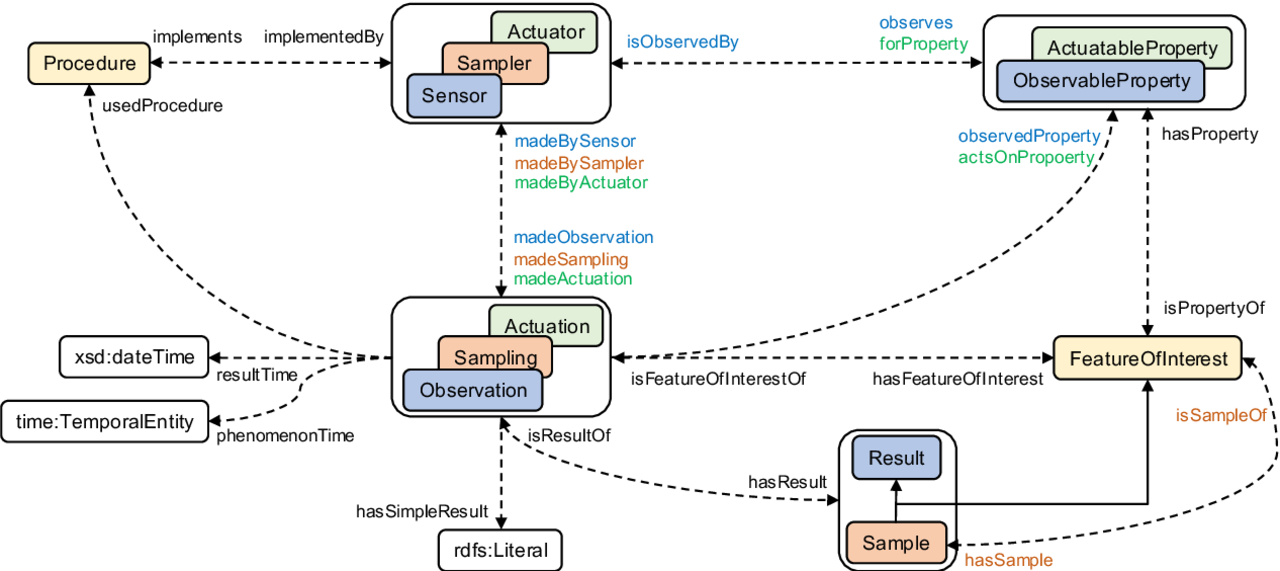
Semantic Sensor Network
Publication: The SOSA/SSN Ontology: A Joint W3C and OGC Standard Specifying the Semantics of Sensors, Observations, Actuation, and Sampling, 2018. https://www.semantic-web-journal.net/system/files/swj1804.pdf
Resource: https://www.w3.org/TR/vocab-ssn/
Description: Semantic Sensor Network Ontology (SSN) provides framework for describing sensors, their observations, and the procedures involved
Example case studies that use this ontology: Smart sensors, Weather data publication, Integrating Oceanographic Sensor Data, Real-time water quality monitoring, Environmental streaming data.
Why we like it: SSN is well-documented, modular, and is frequently updated to incorporate new sensor network models. It can be easily integrated with other foundational ontologies.
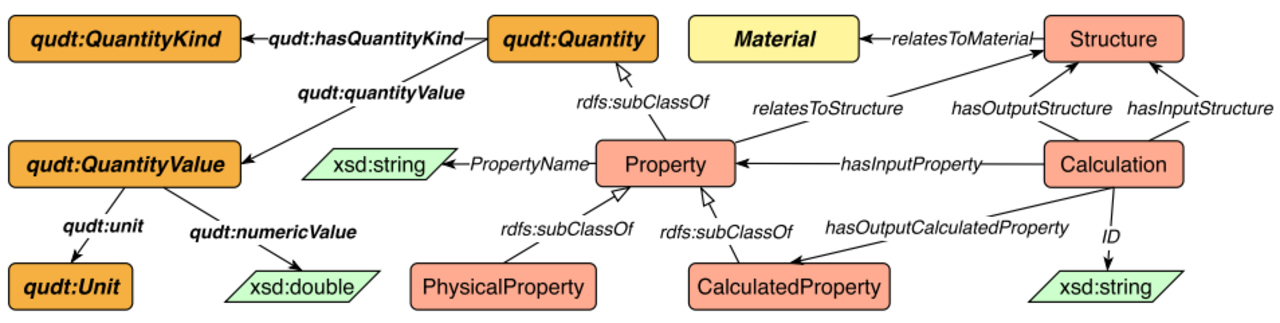
Materials Design Ontology
Paper: https://doi.org/10.48550/arXiv.2006.07712
Ontology: https://github.com/LiUSemWeb/Materials-Design-Ontology
Example case study that uses this ontology: https://huanyu-li.github.io/posters/mdo-poster-paper276.pdf
Description: Materials Design Ontology, concepts and relations representing knowledge in materials design. Designed using domain knowledge in materials science with focus on solid-state physics.
Why we like it: Thoroughly documented from introductory information to underlying axioms. Easily accessible.
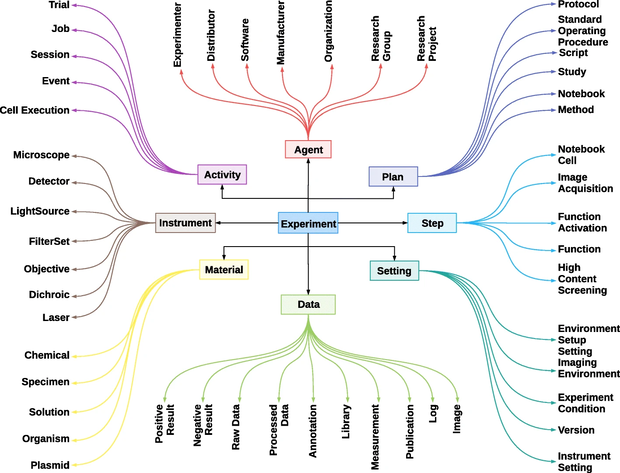
Microscopy: REPRODUCE-ME
Reproduce Microscopy Experiments ontology
Paper: https://link.springer.com/chapter/10.1007/978-3-319-70407-4_4
Resource: https://sheeba-samuel.github.io/REPRODUCE-ME/resources.html
Example case study that uses REPRODUCE-ME: "End-to-End provenance representation for the understandability and reproducibility of scientific experiments using a semantic approach", https://doi.org/10.1186/s13326-021-00253-1
Why we like it: High re-usability potential thanks to the generic enough design and data model. The model also includes reproducibility of computational steps. Further works by the authors use the model in Machine Learning pipelines.
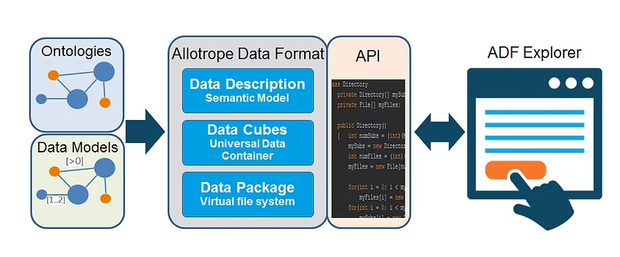
Allotrope Foundation Ontologies
Desription: Allotrope Foundation Ontologies (AFO) provide standard vocabularies, semantic models, file container and software tools for representation of laboratory analytical processes and instruments involved. It is developed by a large international consortium of research institutes, pharmaceutical companies and instrument manufacturers.
Resource: https://www.allotrope.org/ontologies
Example case studies that use AFO: "Creation of Allotrope Ontology and Usage as ELN Metadata", more studies on https://www.allotrope.org/resources
Why we like it: Based on BFO facilitates easier integration with large amount of already available ontologies.
Caveats: Ontology application and documentation more complex and documentation not for beginners. AFO's main application area is chemical analysis.